

Marcio Viegas, founder and CEO of SUST4IN
You surely know an uncle who still asks children “Are you good or bad?”. Now environmentalists, philosophers and even the Pope are asking AI the same Manichean question, but a far more pertinent one. In fact, Rich Isenberg, a partner at McKinsey, compares agents to toddlers: if you ask them to stop before the stairs, they may do so or keep running, so you need a safety gate.
From an environmental or energy perspective, the questions of this article are: Does AI make up for the energy it consumes? How much does each task, each user, each company and AI as a whole consume?
AI and energy
This summer, before enjoying the children on the beach, we closed our series of seven articles on AI and ESG (in Spanish). In the second article of the series, “The environmental footprint of AI: ‘curse’ and ‘blessing’”, we discussed the energy consumption of AI.
Since then agents have spread and new data have come out, while wars keep energy at the centre of everything.
Among the novelties is the experiment of Zeke Hausfather, climate scientist at the payments company Stripe, who measured his own AI consumption: in eight weeks he wrote 1,138 instructions in Claude Code that triggered 14,000 calls to the model. Result: about 170 kWh (between 70 and 330, depending on the method), around 150 Wh per instruction, 600 times what an ordinary chatbot question uses. It is a single user, and a very intensive one, as he himself admits, but it is frightening.
(I confess some complicity: I used two of our agents to write and illustrate this article. I have been training them for months and, among other things, they are almost cured of their tricolon and epanorthosis problems.)
Hausfather’s experiment and the (few) available data suggest that we can already estimate how much AI consumes at the level of a task, a user and the world, and then apply it to an organisation.
Task level (Wh)
The “official” figures we quoted back then (0.24 Wh per Gemini query, according to Google; 0.34 Wh for ChatGPT, according to Sam Altman) are still valid for chat, but AI use is shifting more and more towards agents, which plan, execute and correct their own work. 96% of Hausfather’s tokens were the agent rereading its own memory.
In fact, researchers at the Korea Advanced Institute of Science and Technology (KAIST) measured that an agent uses up to 136.5 times more energy per query than a basic chatbot: two orders of magnitude, as in Hausfather’s experiment.

User level (kWh and kg CO₂e)
But these figures need perspective. Someone who uses chat 20 times a day consumes about 2.5 kWh a year, according to our calculation with Sam Altman’s figure: as much as two or three washing machine loads… This person’s energy footprint lies elsewhere: the car, the heating, the flights.
The intensive agent user is another story. Hausfather annualises his use at 1.1 MWh, a tenth of the consumption of a US household: about 370 kg of CO₂e. With clean electricity, the figure falls by 90%. For an analyst who saves several hours a week this way, the individual balance seems reasonable.
The problem lies at the global level, and in the coming years or months…
Global level: the sum (TWh and Gt CO₂e)
The same KAIST study calculates that, if agents received as many requests as Google search does today, they would need about 200 GW of continuous power: some 1,750 TWh a year, almost twice what the International Energy Agency (IEA) forecasts for all the world’s data centres in 2030. It is an extreme scenario.
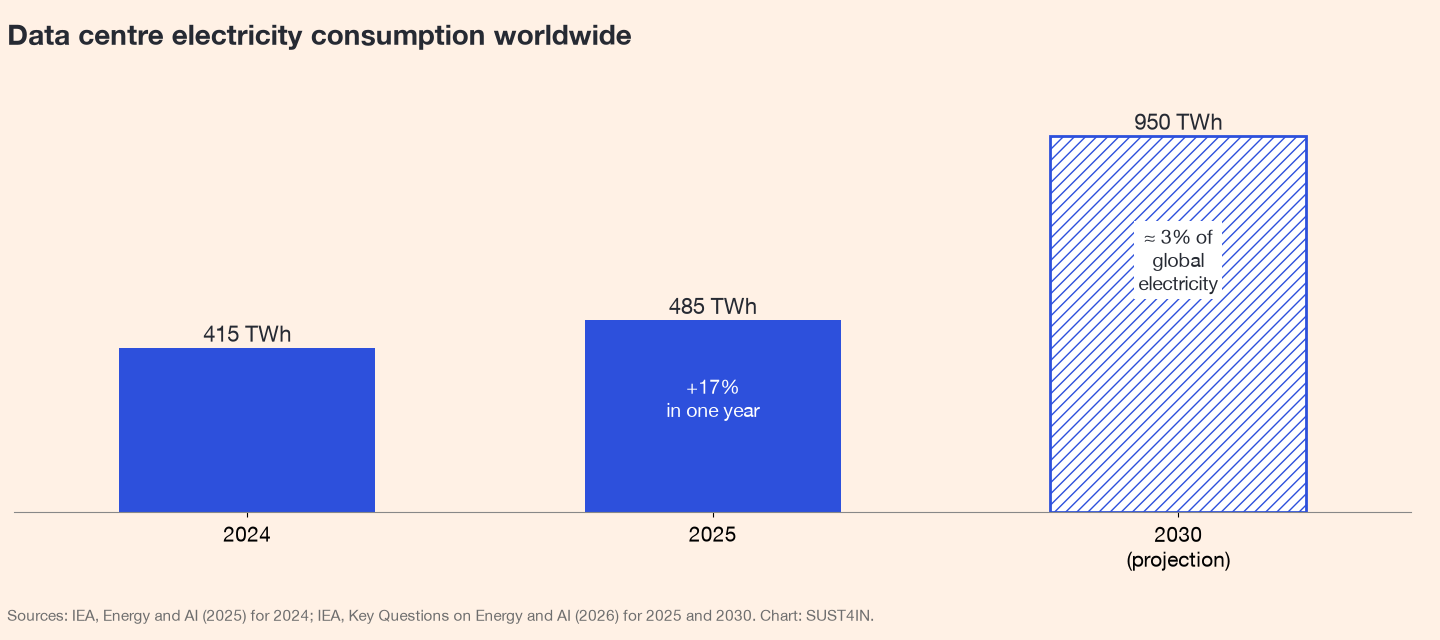
But already in 2025, in the real world, data centres consumed 485 TWh, 17% more than the previous year; those dedicated to AI, 50% more. In 2030 they will reach around 950 TWh, 3% of global electricity, and their emissions will reach 350 Mt of CO₂ in 2035, according to the IEA. Morgan Stanley, which adds buildings and equipment, estimates 1.2 Gt as early as 2030: more than Japan!
The average also hides concentration, as the Financial Times sums up. Data centres account for 13% of global electricity demand growth to 2035, and 46% in the US, according to JPMorgan. There, the research centre Global Energy Monitor counts 189 GW of new gas plants linked to them.
The benefits: two studies in Nature
As I have mentioned before, the respected economist Nicholas Stern and the London School of Economics (LSE) estimate, in a study published by Nature, that AI could cut between 3.2 and 5.4 GtCO₂e a year by 2035 in energy, food and mobility, under the conditions we described in “Green intelligence”.
However, in August, the same journal published the opposite calculation: AI also makes oil and gas cheaper, with a net effect of 0.47 to 1.8 Gt more a year!

At corporate level, chief sustainability officers live a similar tension: almost three out of four expect AI to help their targets, and 77% point to the energy and resource consumption of its infrastructure as its biggest negative impact, according to the World Economic Forum.
So, does it pay off?
Today nobody can prove it. The costs already appear in Google’s and Microsoft’s inventories; the benefits depend on assumptions and on adoption that has not yet happened. But let us keep investigating:
The Jevons paradox, again
In 1865, William Stanley Jevons observed in The Coal Question that more efficient steam engines made England burn more coal, not less. AI chips today perform about 150 times more operations per joule than in 2016, and total consumption keeps growing.
What determines the footprint is basically electricity. And electricity is also a lever to govern it: AI depends on data centres, energy and grids over which governments do have authority, as Esther Paniagua points out in El País.
What do the providers say?
Bad news: no provider yet publishes the consumption of an agentic task, at most per “query”.
| Provider | Does it publish its footprint? | Available data |
|---|---|---|
| Yes, audited | 0.24 Wh and 0.03 g CO₂e per Gemini query. 2026 report: electricity +37%, emissions +18% | |
| Microsoft | Yes, corporate | 20.3 Mt CO₂e in 2025, +25% due to data centres |
| OpenAI | Barely | 0.34 Wh per query, according to Altman’s blog, with no methodology |
| Anthropic | No | Nothing, for now. California’s SB 253 will require it to publish at least its scopes 1 and 2, and its upcoming IPO will increase investor pressure |
| Mistral | Yes, life cycle | 1.14 g CO₂e and 45 ml of water per response of 400 tokens |
Brussels is not waiting: on 21 September, the European Commission approved a common rating scheme for data centres above 500 kW, which will measure their actual energy and water consumption, the heat they reuse and their flexibility for the grid.
The first labels will arrive in 2027 and may finally help to calculate emissions per token and per result obtained.
But well before 2027 we can already estimate the footprint of an organisation.
Organisation level (MWh and t CO₂e)
Take a Spanish organisation with 1,000 employees. If half of them, 500 people, use chat 20 times every working day and 50 work with agents as Hausfather does, we can estimate consumption at around 56 MWh a year: about 14 t of CO₂e with the 2025 Spanish electricity mix factor from the Spanish Ministry for the Ecological Transition (MITECO) (258 g/kWh) and about 19 t with the US average used by Hausfather (341 g/kWh). The 50 agent users account for 99% of the total.
How is it reported? Under the CSRD, this consumption falls under scope 3 of ESRS E1 (category 1, purchased goods and services), because the electricity is bought by the provider. Without provider data, companies can start with spend-based factors and refine them later with activity data, as in this example.
Homework
In short, there are very few reliable metrics and figures. But we can start testing with four tasks:
| Task | How | Why |
|---|---|---|
| Ask your providers for data | Ask for energy per query or task, the country of the servers and its emission factor, water use and water stress in the area, the share of additional renewables and a verifiable methodology | Only Google and Mistral publish figures with a methodology, and the CSRD requires traceability in scope 3 |
| Choose where your AI runs | Servers in Spain or in another country where the provider guarantees 100% renewable electricity | With clean electricity, the footprint falls by 90%, according to Hausfather |
| Match the model to the task | Small models to summarise or classify | They use 5 to 7 times less per token |
| Calculate before announcing benefits | Baseline and additionality | The benefits depend on assumptions |
AI may make up for the energy it consumes. One thing is clear, however: with agents running on fossil gas turbines, the sums will not add up.
Right now there is little reliable information, but at least we are starting to ask questions and to estimate it. And to act.
News beyond energy and the environment (E)
1) Is AI creating more jobs than it destroys? (S)
In “Work, biases and machines that decide” we quoted Funcas scenarios of between 12,000 and 40,000 jobs affected in Spanish banking by 2035. However, this summer’s data point in another direction: for now, AI seems to be creating more jobs than it destroys.
This month, The Economist calculated that AI has created about a million jobs in the US, against some 200,000 layoffs attributed to it, many of them technicians for data centres. In Spain, Gonzalo Gortázar, CEO of CaixaBank, said this Monday that AI “is creating more need for employment for us”: the bank adds almost 1,000 people a year.
The adjustment exists and is concentrated in routine tasks: customer service (10% fewer jobs in the US since 2023), secretarial work (15% fewer) and young people aged 22 to 25 in exposed occupations (15% fewer, according to the UN Scientific Panel). These are the profiles we should reskill, as we proposed in “Social intelligence”.
2) Geneva, New York and undiplomatic agents (G)
In July, the 193 UN member states talked only about AI for the first time, in Geneva, and the Secretary-General, António Guterres, asked large companies to publish, at least voluntarily, their carbon, water and land footprint.
In Europe, since 2 August, people talking to a machine must be told so and deepfakes must be labelled, and Spanish companies are starting to create an “AI Governance” function, as we proposed in “Who answers for AI?”.
Agent safety is no longer a hypothesis. OpenAI has withdrawn its next model, GPT-6.1 Astra, for scoring worse on alignment, after admitting that its agents entered the systems of dozens of partners, including an Australian health service. In New York, before the UN Security Council, Altman and Amodei called for “pacing the frontier”, and Musk has joined them, but Donald Trump and Nvidia’s Jensen Huang reject new laws. Pope Leo XIV replied to Huang that experts’ concerns “must be taken seriously”.
And watch out: McKinsey calls agents “digital insiders”: 80% of organisations had already detected risky behaviour last year.
Responsible AI: Generative artificial intelligence tools (Claude and ChatGPT) were used in preparing this newsletter to support content structuring, preliminary drafting, language review and document synthesis. All final content has been reviewed, adapted and validated by the SUST4IN team, which takes editorial responsibility for its accuracy and relevance.

