

Marcio Viegas, founder and CEO of SUST4IN
In recent days, besides new cases of AI agents scraping data from the websites of public bodies and hackers using AI against banks, we learned that Uber, the modern taxi, used up its AI budget for the whole of 2026 in April. Four months! “We budget with what we know, but this changes very fast. Every week there is a tectonic shift,” admitted its chief technology officer, Praveen Neppalli Naga.
At Amazon, an internal project overran its budget by 860% because some unfinished tasks kept working in the background for five months: more than a million dollars (about 900,000 euros). Nobody watches them, because that is precisely what an AI agent promises: to work on its own.
This runaway AI spending may be happening in many companies (at SUST4IN, certainly), and in sustainability departments, especially the most advanced ones. Better to understand very well how to estimate the costs and, of course, the impacts of AI.
In my last column, “AI, good or bad child?”, we measured the energy of AI. Today we add the economic bill and join the two through their common unit, the token. I have divided the article into three parts: how tokens work, how much they cost and, following on from the last article but now at token level, how much energy and how many emissions lie behind them.
1. How tokens work
A token is a piece of text
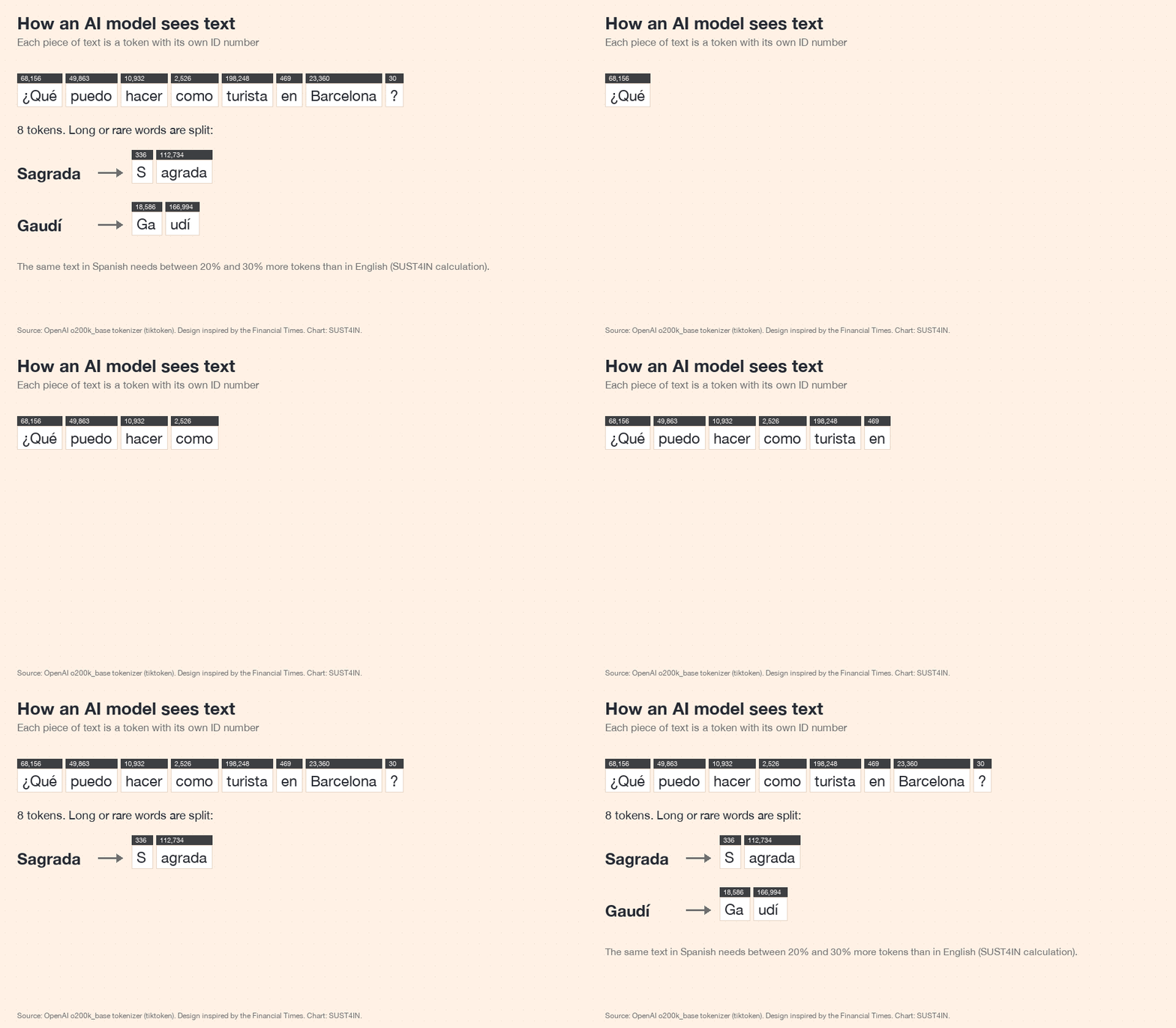
AI models cut what we write into tokens: whole words, fragments or signs, each with an identification number. The Spanish question “¿Qué puedo hacer como turista en Barcelona?” (What can I do as a tourist in Barcelona?) is 8 tokens. “Sagrada” is two (“S” and “agrada”), and “taxímetro” (taxi meter), three (“tax”, “í” and “metro”), according to OpenAI’s tokenizer.
Spanish pays for more tokens
Anyone who has had to fit a text into a sustainability report or an article knows that Spanish needs more words than English to say the same thing.
The same happens with tokens, and at SUST4IN we measured it with FLORES-200, the corpus academic literature uses to compare languages: we counted its 2,009 public sentences with seventeen tokenizers. With GPT-3’s tokenizer (2020), Spanish needed almost twice as many tokens (+98%); with GPT-4’s (2023), 55% more; with the current ones from OpenAI, Google and Meta, around 30% more.

Our results match those published by Oxford researchers in 2023. Since FLORES-200 belongs to Meta, we checked it against two independent texts: the official translation of the CSRD directive (+27% with GPT-4o’s tokenizer) and the news stories universities use in the annual WMT machine translation competition (+20%).
Most of that premium is unavoidable: depending on the text, Spanish is between 10% and 19% longer than English, and the tokenizer “only” adds about 10 points. That is why the most recent tokenizers, such as Google’s Gemma 4 (2026), Meta’s Llama 4 or Alibaba’s Qwen 3.5, no longer bring it down.
With the same price and the same energy per token, in Spanish we pay and consume between 20% and 30% more for the same content, and up to 25% less text fits in the model’s memory. The method note and the data are available on request.
Each new token rereads all the previous ones
The model generates the answer token by token, and calculates each one by looking at all the previous ones. The longer the sequence, the more computation each step requires.

That working memory, the context window, has grown from 4,096 tokens in the “old” GPT-3.5 of 2022, about 3,000 words, to one million in most current models.

Source: Financial Times, with data from Meibel.
And consumption multiplies by ten every year: Google processed 9.7 trillion tokens a month in May 2024 and 3.2 quadrillion in May 2026.

Source: Financial Times, with data from Exponential View.
A conversation about the Sagrada Familia
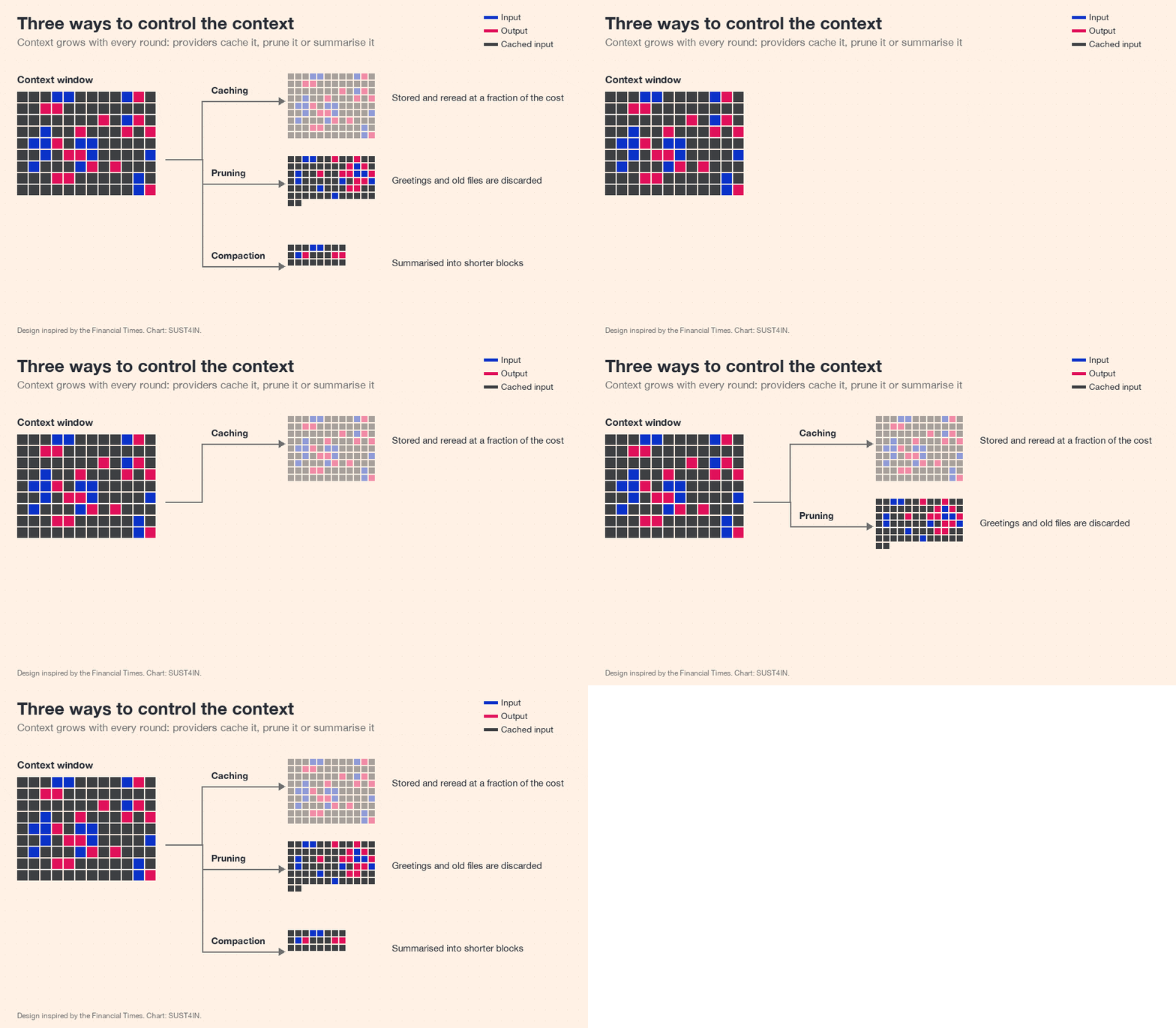
Some of us tourists already use AI as a guide. Imagine a first-time tourist in Barcelona and the questions we saw before: “What can I visit?”. “The Sagrada Familia is a good starting point”. “When was it started?”. The model has no memory of its own: to know what we are talking about, it rereads the whole conversation, plus some hidden instructions from the provider. Each question pays again for everything before it. To contain this, providers cache the context, discard what is irrelevant or summarise it.
When the one asking is an agent
An agent plans, opens files, uses tools and reviews its work. Each step is a new call to the model with all the accumulated context, without anyone typing anything. A not overly complex example from our trade: calculating the scope 2 emissions of a company from the electricity bills of its 40 offices. We write two sentences; in our simulation, the agent makes 120 calls and processes 9.6 million tokens. And our agent is already fairly optimised!
Worse still: coding agents consume 1,000 times more tokens than a chat about code, according to researchers from Stanford, MIT, Microsoft and Google DeepMind who measured it, and almost all of it is context being reread.

Source: Financial Times, with data from OpenRouter.
2. How much they cost
The bill has tiers, like the electricity bill
| Token type | What it is | Price in Claude Opus 5.5 |
|---|---|---|
| Input | The question, the instructions and the history that is sent again | $4 per million (€3.56) |
| Cached input | Context the provider stores and reuses | $0.20 per million (€0.18), 5% of input |
| Output and reasoning | The answer and the previous steps the model “thinks” | $20 per million (€17.82), five times input |
Source: Anthropic list prices in October 2026, at €0.891 per dollar.
As you can see, models charge five times more for outputs, their answers, than for inputs, our questions. The technical reason is that output tokens are calculated one at a time and are slower. Clearly, the labs want to encourage us to ask complicated questions so they can charge us for the answers. And, of course, the assistant will ask you for a photo of the Sagrada Familia so it can explain the façade.
The agent that calculates the scope 2 emissions of the 40 offices, for example, would cost about €2.60 with caching and €35 without it.

The Silicon Data index and the token at half price
Just as Brent is the benchmark for the price of oil, the new Silicon Data index aims to be the benchmark for the token: it tracks what the market pays for a million tokens.
Good news: the token price has fallen 52.4% from its May peak, when it came close to $2.07, and is back to its level of late 2025.

Source: Financial Times, with data from Silicon Data and Bloomberg. Dollars per million tokens.
But the story is more complicated than the chart. That number mixes three deflations: the technical one (each token costs less to produce), the mix one (companies divert minor tasks to cheap open models) and the competitive one (a price war). A million tokens from frontier models has fallen from about $50 at the end of 2023 to about $6 (from €45 to €5), while the market median has stayed slightly below one dollar since 2024.
The same task, thirty times more expensive
The biggest problem for a chief financial officer is unpredictability. In the Stanford study, the same task, repeated, consumed up to 30 times more tokens in one run than in another (9.5 million against 316,000) and cost $16 (€14) against 85 cents (76 euro cents). Spending more did not guarantee a better result either. “Agents are not trained to be budget-aware,” explains Jiaxin Pei of the University of Texas at Austin.

Source: Financial Times, with data from Bai, Pei et al. (2026). Tokens and cost per task across 500 coding tasks.
Uber has responded with a cap of about $1,500 a month per tool (€1,340), cheaper models for simple tasks and caching. Using the most powerful model for everything is like asking a director to do the photocopying.
From the taxi meter to the flat fare
Today we pay for the computation consumed, regardless of the value obtained. The Madrid taxi offers the analogy. Around the city you pay by the meter: if there is a traffic jam on the Castellana, the meter keeps running and the customer pays. Between Barajas airport and the city centre there is a flat fare, and the driver absorbs the traffic jam. With agents, if they go round in circles, the company pays for every token. “What matters is the price per task,” said OpenAI president Greg Brockman in September, and OpenAI is already testing payment by result. The issue already weighs on the upcoming IPOs. Anthropic lost more than $8 billion last year (€7.1 billion) and has signed infrastructure commitments worth $518 billion (€461 billion). “If you look at 2027, nobody knows what they are going to earn,” sums up Joey Brookhart, an analyst at SemiAnalysis.
3. How much energy and how many emissions
Each token, a few milliwatt hours
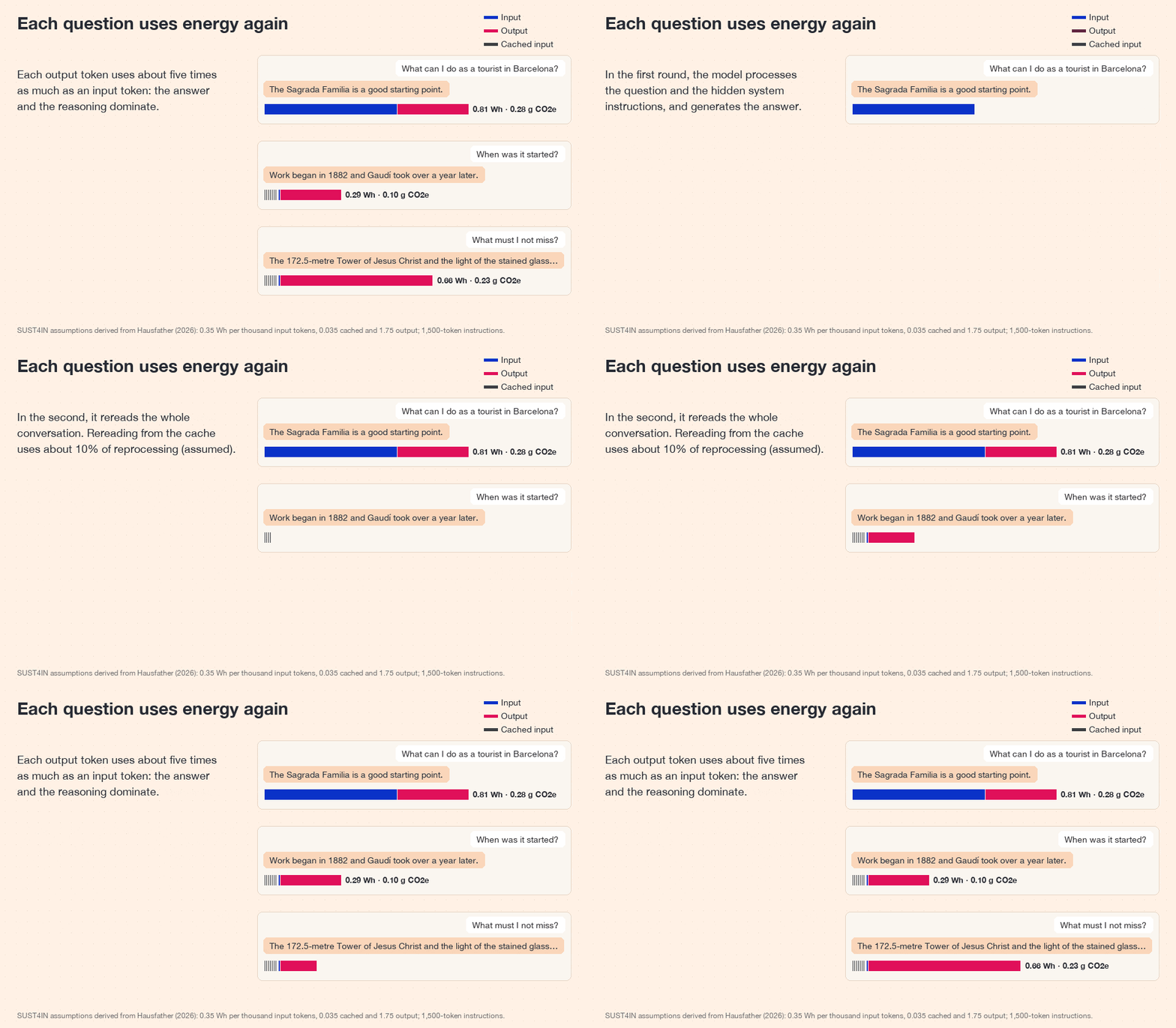
“The closest thing to a token is a kilowatt hour,” says Yale economist Aleh Tsyvinski. I would say a milliwatt hour: by our calculations, between 0.04 and 1.75 milliwatt hours per token, depending on the tier. The problem is that we use millions, even trillions, of tokens!
As we saw in the last article, no provider publishes energy per token, but Zeke Hausfather, climate scientist at Stripe, measured his own agent use: 3.2 billion tokens and about 170 kWh in eight weeks. Our factors come from there, with an uncertainty of a factor of two:
| Token type | Energy per million tokens | g CO2e per million (US / Spain) |
|---|---|---|
| Input | 0.35 kWh | 119 / 90 |
| Cached input | 0.035 kWh | 12 / 9 |
| Output | 1.75 kWh | 597 / 452 |
SUST4IN calculation with emission factors from the US Environmental Protection Agency (341 g/kWh) and the Spanish Ministry for the Ecological Transition (MITECO) (258 g/kWh).
The conversation about the Sagrada Familia, with its roughly 5,200 tokens, would use about 1.8 Wh, around a seventh of what it takes to charge a mobile phone (about 12 Wh), and about 600 mg of CO2e with the US electricity mix (450 mg with the Spanish one).
The 40-office agent uses 1,800 times more tokens and about 230 times more energy: about 0.4 kWh and 140 g of CO2e; without caching, 3.4 kWh. All to calculate an inventory measured in tonnes. In other words, the agent is only the messenger: the problem is the tonnes we emit in other activities. Don’t shoot the messenger!
Cheap tokens, like cheap oil
At the bottom of the market, a million tokens costs about $0.11 (10 euro cents), which according to analyst Jay Goldberg is “basically the cost of electricity”. In the cheapest models, the milliwatt analogy becomes literal.
We have already seen with oil what happens when a resource becomes cheaper. After the 2014 oil price collapse, petrol consumption in Spain rose in 2015 for the first time since 1998, according to CORES, the Spanish strategic oil reserves agency, and in the US it beat the 2007 record in 2016. And petrol is “inelastic”: a 10% price cut barely raises consumption by 1% in the first year, according to the meta-analysis by Tomáš Havránek and colleagues.

With tokens it is harder to isolate the effect of price on consumption. The price for the same level of performance falls about 13 times a year, according to Epoch AI, but the median paid by customers has been almost flat for two years, and even so consumption multiplies by ten. It grows mainly because models do new things, such as agents, and falling prices speed it up. For the climate, the result looks like that of cheap oil: more total consumption.
Deflation weighs differently on the footprint depending on its origin. Technical and mix deflation also reduce energy per token: more efficient chips and smaller models, which use 5 to 7 times less. Competitive deflation only makes tokens cheaper. If consumption grows faster than energy per token falls, emissions rise even if each token is cleaner: the same paradox Jevons saw with coal in 1865.
We subsidise oil, but we also tax it and charge emission allowances for part of what its price leaves out, although not everywhere in the world. The token carries, at most, the carbon of the data centre’s electricity. For a company, the practical answer is to set its own limit: an AI budget in kilowatt hours too, or an internal carbon price applied to its use. It will not be much, with the little information we have and without counting the “life cycle” of the token, but we have to start estimating it.
The bill we do not pay directly: training
Everything above measures use. Before that, however, the model has to be trained, and we do not pay that bill: investors finance it. But it consumes energy and emits. It is the beginning of the token’s life cycle!
| Model | Training | Source |
|---|---|---|
| GPT-4 (2023) | 42.4 GWh in 14 weeks: each day of training, the consumption of 28,500 households in advanced economies | IEA |
| Llama 3.1 405B (2024) | 8,930 t CO2e location-based; 0 t market-based, because Meta buys renewable electricity | Meta |
In 2024 OpenAI spent about $5 billion (€4.45 billion) on compute for research and training, and $2 billion (€1.78 billion) on inference, that is, on using the model to answer its users, according to Epoch AI. With agents, the balance tilts towards use. For scope 3 calculations, there are two lessons: a per-token factor that only counts use underestimates the footprint of the service, and, especially in the world of data centres, the method (location-based or market-based) matters, because the same Meta footprint, according to its own data, is 8,930 tonnes or zero.
Our reading and suggestions
The token has become the accounting unit of AI, and it serves three accounts at once: computation, money and energy. In all three, the unit price falls and volume eats up the efficiency gains (Jevons again, apologies for being repetitive). Oil has already taught us that a cheap resource is consumed and pollutes more, and the token repeats the lesson with consumption that multiplies by ten every year.
For a company (or a sustainability department) starting out with agents, the recipe is simple:
- a budget per team;
- the right model for each task;
- measure what you get in return, in euros and in kilowatt hours.
Ronnie Chatterji, OpenAI’s chief economist, sums it up well: “The idea that all tokens are equal is just an artefact of the fact that we can count them.”
Gaudí devoted 43 years to his work and left it half finished. The basilica has been under construction for 144 years, financed by donations and the tickets of millions of visitors. AI agents work rather faster. But their runaway budget, for now, looks more like the Sagrada Familia’s.
Other news
Spain’s Royal Decree on data centres
AI, including data centres, is a huge and immediate opportunity for Spain, but it must be viable, responsible and sustainable. Along these lines, the Government seems to want to approve this very month the Royal Decree that will regulate data centres in Spain, and the controversy is on.
The draft starts from a curious diagnosis: Red Eléctrica and the distribution companies have already granted these facilities more than 12 GW of grid access, while Spain’s Artificial Intelligence Strategy forecasts demand of between 3.5 and 4 GW by 2030.
The requirements apply to centres above 1 MW. Until the European label arrives, planned for August 2027, they must have a power usage effectiveness (PUE) of 1.15 (at most) and a water usage effectiveness (WUE) of 0.1. They will have to cover 80% of their consumption with new renewables, commissioned no more than 18 months earlier, through self-consumption or forward contracts, and match consumption and generation hour by hour. There will also be resilience and digital sovereignty requirements. Non-compliance is expensive: surcharges on grid tolls of up to 500% and, in serious cases, loss of grid access.
Pedro Sánchez defended it in an article in Bloomberg: any increase in electricity demand must be accompanied by additional renewable capacity. And he summed up: our goal must be to trade in bytes, not watts. The industry association SpainDC replies that 9 billion euros of investment are at stake and that three international companies will freeze their projects if the text goes ahead. “What is not negotiable is that Spain becomes the most restrictive country in Europe,” says its director, Begoña Villacís.
It is the logic of “AI now runs on a taxi meter” applied to the grid: if electricity remains available to whoever arrives first, consumption will grow faster than renewables. Requiring new, hour-by-hour renewables is what Spain already asks of renewable hydrogen, and it is in fact the same as what the ongoing revision of GHG Protocol scope 2 proposes. We shall see whether the final text keeps the 80%.
Responsible AI: Generative artificial intelligence tools (Claude and ChatGPT) were used in preparing this newsletter to support content structuring, preliminary drafting, language review, document synthesis, calculations, charts, animations and layout. All final content has been reviewed, adapted and validated by the SUST4IN team, which takes editorial responsibility for its accuracy and relevance.

