

Marcio Viegas, founder and CEO of SUST4IN
COP31 opens in Antalya on Monday. Officially it runs until Friday 20 November, but COPs always end on a Saturday or a Sunday. I will be there, once again, until the end.
What can we expect? Like the last few, this will be another “implementation” COP (the thirtieth, for the cynics): a procedural package, a few new coalitions and no progress in the formal texts on fossil fuels, the main cause of the climate crisis.
An unusual COP
COP31 has two presidencies. Türkiye hosts the summit, with Murat Kurum as President and in charge of the Action Agenda. Australia’s Chris Bowen is “President of Negotiations”, with exclusive authority over the texts. In their latest joint letter to the parties, they sum up the spirit of Antalya in one sentence: “Submission is essential, but implementation is the ultimate test”. The earlier letters and the other presidency documents are on The Road to Antalya.
Simon Stiell, the UN’s climate chief, describes the context as a “new world disorder”. The war in the Middle East has been cutting oil supply for almost eight months, an El Niño is forming and August 2026 was the hottest month on record. Fatih Birol (IEA) admits that this COP has drawn less attention than previous ones, and still believes that 2027 could put climate back at the top of the agenda.
The ambition gap
Global emissions remain at record highs. According to the UNFCCC NDC synthesis report, published on 27 October, current plans have not yet made them peak: they would peak before 2030 only if the pledges conditional on finance are also met, and in 2035 they would be 6-9% below 2019 levels. The IPCC’s 1.5°C pathways require around 60%.

The host illustrates the growth dilemma: its NDC allows its emissions to rise from 552 MtCO₂e in 2023 to 695 in 2030 and 643 in 2035. Its 2025 Climate Law creates an emissions trading system modelled on the EU’s, with a pilot phase this year.

Paris works, if slowly. As El País recalls, using UN data, the warming expected by the end of the century under current policies has fallen from 3.7°C in 2015 to 2.8°C in 2025, and meeting every pledge would bring it to 2.3-2.5°C. UNEP is clear in its Limiting Overshoot report: the world will exceed 1.5°C in the coming years and, even in the most optimistic scenario, warming would peak at 1.8°C. There are no harmless scenarios above 1.5°C. Cutting methane is the fastest lever, and forests are not enough: it would take more than a hundred years of afforestation at the current pace to cool the planet by 0.1°C.

Science and nature
Science is negotiated too. The second Global Stocktake starts in Antalya and ends in 2028, and many countries want the next IPCC report to arrive in time to inform it. Russia and Saudi Arabia are holding it back: the last IPCC meeting, in Addis Ababa, was suspended without agreement on the timetable, according to The Economist.
Antalya also comes ten days after the COP17 on biodiversity in Yerevan, which closed on 31 October with a fragile deal: the world is off track on 22 of the 23 targets for 2030, and finance (with the Cali Fund almost empty) was again the sticking point. The Earth Negotiations Bulletin has the details. The oceans and the “Rio Synergy” on the Turkish agenda are the natural bridge between the two conventions.
What outcomes do we expect?
| Outcome | Probability |
|---|---|
| Negotiated package adopted by consensus | High, though its ambition is another matter |
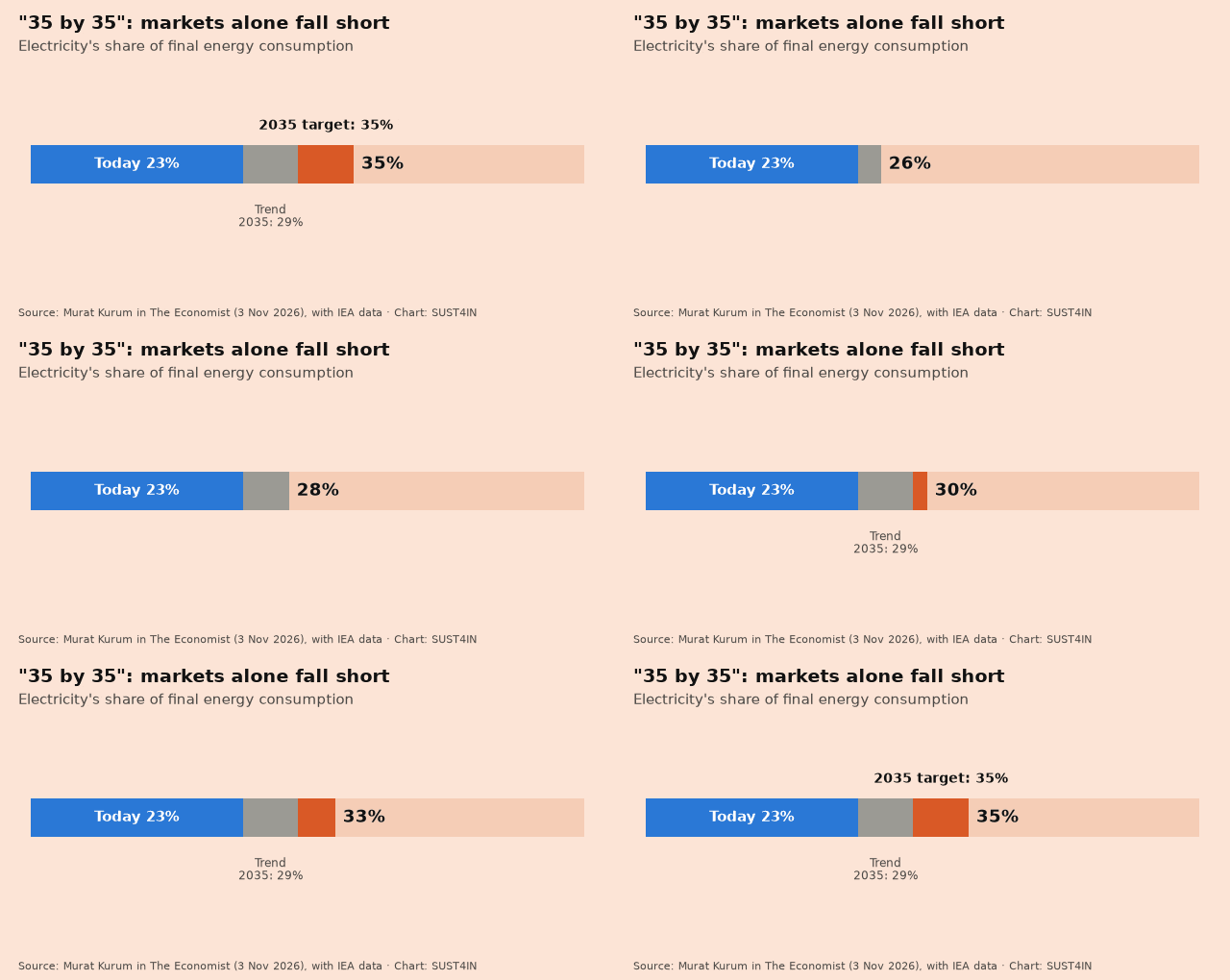
| “35 by 35” electrification pledge (35% of final energy in 2035, up from 23% today) | High, as a voluntary coalition |
| Antalya Declaration on the oceans | High |
| Launch of the second Global Stocktake, which concludes in 2028 | High |
| Adaptation indicators and a path to triple adaptation finance | Medium |
| Just transition mechanism (“Belém-Antalya mechanism”) up and running | Medium |
| New quantified finance on top of Baku’s $300bn | Low |
| Roadmap to transition away from fossil fuels in the formal decision | Very low |
| United States back at the negotiations | Impossible before COP34 (see below) |
| Other countries leaving the negotiations | Very low |
Five priority topics
Electrification
How many countries sign the “35 by 35” pledge, and whether the big emitters are among them. Kurum explains in The Economist that the market alone will not get there: on current trends, electricity would rise from 23% to 29% of final consumption by 2035. According to the IEA, the 35% target would save more than $500bn a year in fuel imports, and requires investing close to $1trn a year in grids and storage until 2030.
The war in the Middle East has done more than any summit: importing countries are spending $1.8bn more a day on fuel and electric car sales have soared, according to El País. In Portugal and Belgium they are already one in every two cars sold. The European doubt, set out in EU Council documents, is that the target does not require the new electricity to be clean. The WBCSD and We Mean Business, for example, have already made it their priority for Antalya. Money is following: in 2025 global clean energy investment reached $2.2trn, twice the amount invested in fossil fuels, according to the IEA.
Finance
The Climate Implementation Bridge (which, the presidency insists, is not a fund) and the goal of mobilising $1.3trn a year by 2035. Interest rates complicate matters: Moritz Kraemer explains in the FT that each one-point rise in the term premium on US bonds has historically raised emerging markets’ local-currency borrowing costs by 1.5 points. He proposes carbon taxes, IMF special drawing rights, solidarity levies on aviation and shipping and the securitisation of official development assistance. Developing countries are pushing for more public money (Article 9.1). The United Kingdom, meanwhile, is halving its climate finance.
Adaptation
Adaptation needs between $310bn and $365bn a year, against $26bn mobilised in 2023, according to UNEP. The bill for not adapting is already arriving: disasters cost the world $450bn in a normal year, and 62% of that is uninsured, according to Verisk.


Fossil fuels
The Brazilian COP30 presidency is due to present, before Antalya, its roadmap to end dependence on oil, gas and coal. Nine former leaders, among them Mary Robinson, Juan Manuel Santos and Laurence Tubiana, have called in a letter to the FT for governments to act on it and speed up methane cuts. The 57 countries in the Santa Marta process may announce national roadmaps outside the consensus texts.
Carbon markets
Article 6 is starting to work, Türkiye is piloting its emissions trading system and the EU, Brazil and China lead a coalition of compliance markets with 18 countries.
The agenda, day by day
The official programme devotes a day to each major theme. They are all priorities and it is hard to choose, but I will follow the themes in bold closely:
| Day | Theme |
|---|---|
| Monday 9 | Food, agriculture and health |
| Tuesday 10 | Energy and transport |
| Wednesday 11 and Thursday 12 | Leaders’ Summit. Zero waste and resilient cities |
| Friday 13 | Finance and trade |
| Saturday 14 | Children, youth, education and skills |
| Monday 16 | Science, industry and technology |
| Tuesday 17 | Oceans, nature and land use |
| Wednesday 18 | Human and social development |
| Friday 20 | Final negotiations |
Europe and Spain
The EU is calling for a step change in implementation and for the urgent submission of outstanding NDCs. At home, Brussels is preparing for the worst: the Commission’s proposal asks member states to plan their adaptation for 3°C of warming. Heat contributed to some 50,000 deaths in Europe this summer, and the Commission estimates that adaptation will cost €70bn a year until 2050, according to the FT. Spain has asked, in a letter from minister Sara Aagesen to the commissioner, for a study of an EU tax on the profits of oil and gas companies to pay for it, and for climate risk to become mandatory in public planning. Unfortunately, neither made it into the Commission’s proposal.
Spain’s priorities are clear: electrification with renewables, multilateralism, science, a just transition and adaptation, plus support for the “35 by 35” pledge if the electricity is clean. The general election on 29 November, nine days after the COP closes, does not change that position.
Four trends for business
These four trends may matter more than Antalya’s final decision:
- Climate transition plans are becoming investment plans. Investors, banks and NGOs ask for them, and so does regulation (IFRS, CSRD/ESRS and others).
- The economy is already electrifying and needs to electrify further. The share of electricity in energy consumption will make its way, if it is not there already, into investor questionnaires.
- Carbon pricing crosses borders. CBAM has been in its definitive phase since January and Türkiye is aligning its emissions trading system with the EU’s. It is worth reviewing the exposure of suppliers and subsidiaries in Türkiye and in other countries, whether or not they have an emissions trading system.
- Physical risk is already material. After the carbon footprint and transition plans, the next step is climate resilience plans, or “adaptation” in COP jargon. With the Brussels proposal, the 3°C scenario stops being an academic exercise.
A positive, if modest, step
I have been attending climate COPs (not all of them) since Milan in 2003, and it is still hard to predict what will happen at each one. We try: in 2015, days before the historic COP21 in Paris, we published our forecasts: an agreement very likely, a binding one unlikely, no global carbon price and no widespread net zero commitments. We got the agreement and the carbon price right. The legal form was a draw (a binding treaty with non-binding national targets) and net zero arrived much earlier than expected.
Twenty-two years ago I described the now defunct Kyoto Protocol as “a positive, if modest, step” for carbon markets. Antalya will probably deserve the same label. In a decade of overshooting 1.5°C, the good news would be that the steps agreed in recent years are finally implemented.
BREAKING · US ELECTIONS
The Democrats have just won the elections. Can the US return to the COPs?
The Democrats won control of both chambers of Congress yesterday, according to ABC News projections. However, the return of the United States to the climate negotiations remains in the president’s hands, although, curiously, its withdrawal from the Framework Convention does not take effect until 27 February 2027. So, at best the country would return at COP34, in 2029. But not everything depends on the current president.
The first piece of good news, let us not forget, is that no other country has left the negotiations, and that possibility is now even more remote.
Second, as I explained above, economics and energy security are accelerating climate action more than any summit.
Third, the new Congress controls the budget: it can resume funding the Convention, the IPCC or the Green Climate Fund, although any law needs the president’s signature. Here too, the effect will be felt from 2029 at best.
By the way, an “oil” paradox: the war in the Middle East has changed the “regime” in Texas or Kansas, not in Iran.
How to follow the COP
- Official information: the UNFCCC COP31 page, with the daily schedule and live plenaries, the presidency’s website, cop31.tr, with its Action Agenda, and the basic guide from Spain’s Ministry for the Ecological Transition (in Spanish).
- Climate action by companies, cities and investors: the revamped NAZCA portal.
- Daily coverage: the Earth Negotiations Bulletin to follow the negotiations day by day and Carbon Brief for analysis and key data.
- Voices to follow: Simon Stiell (UN Climate Change), António Guterres (UN), María Mendiluce (We Mean Business Coalition) and Christiana Figueres, also on the Outrage + Optimism podcast.
- Yours truly: as always, I will post summaries and videos on LinkedIn and in the SUST4IN newsletter (in Spanish).
Responsible AI: Generative artificial intelligence tools (Claude) were used in preparing this article to support research, content structuring, preliminary drafting, document synthesis and charts. All final content has been reviewed, adapted and validated by the SUST4IN team, which takes editorial responsibility for its accuracy and relevance.

